
NCCL Multi-Rail Broadcast with More GPU Ranks#
Abstract#
NCCL broadcast is used to synchronize model weights between training workers and rollout engines in frameworks such as Slime. However, having multiple RDMA NICs per node does not guarantee that a broadcast will use them all. In our single-sender setup, weight transfers use only the source GPU’s local NIC pair, leaving most of the node’s network capacity unused. This note compares one and eight participating GPUs on the source node, with eight receivers in both cases, to show how rank placement affects NIC utilization and weight-transfer throughput. On two Cambrian H100 nodes, expanding the source node from one to eight ranks increases median broadcast throughput from 47.86 to 290.17 GB/s, a 6.06x speedup within one process group.
Introduction#
When a node has multiple RDMA NICs, it is natural to expect a large broadcast to use their combined bandwidth. Reaching that bandwidth, however, requires traffic to flow through multiple NICs in parallel. In NCCL, those paths depend on the participating GPU ranks, the GPU-to-NIC topology, and the communication layout. The simplified diagram below illustrates a single sender GPU broadcasting through its local network connection. On the Cambrian nodes used in our experiments, that connection consists of two 200 Gb/s ports combined by NCCL into one 400 Gb/s virtual device. The question is how to involve the other GPUs and NICs to use more of the node’s available bandwidth.
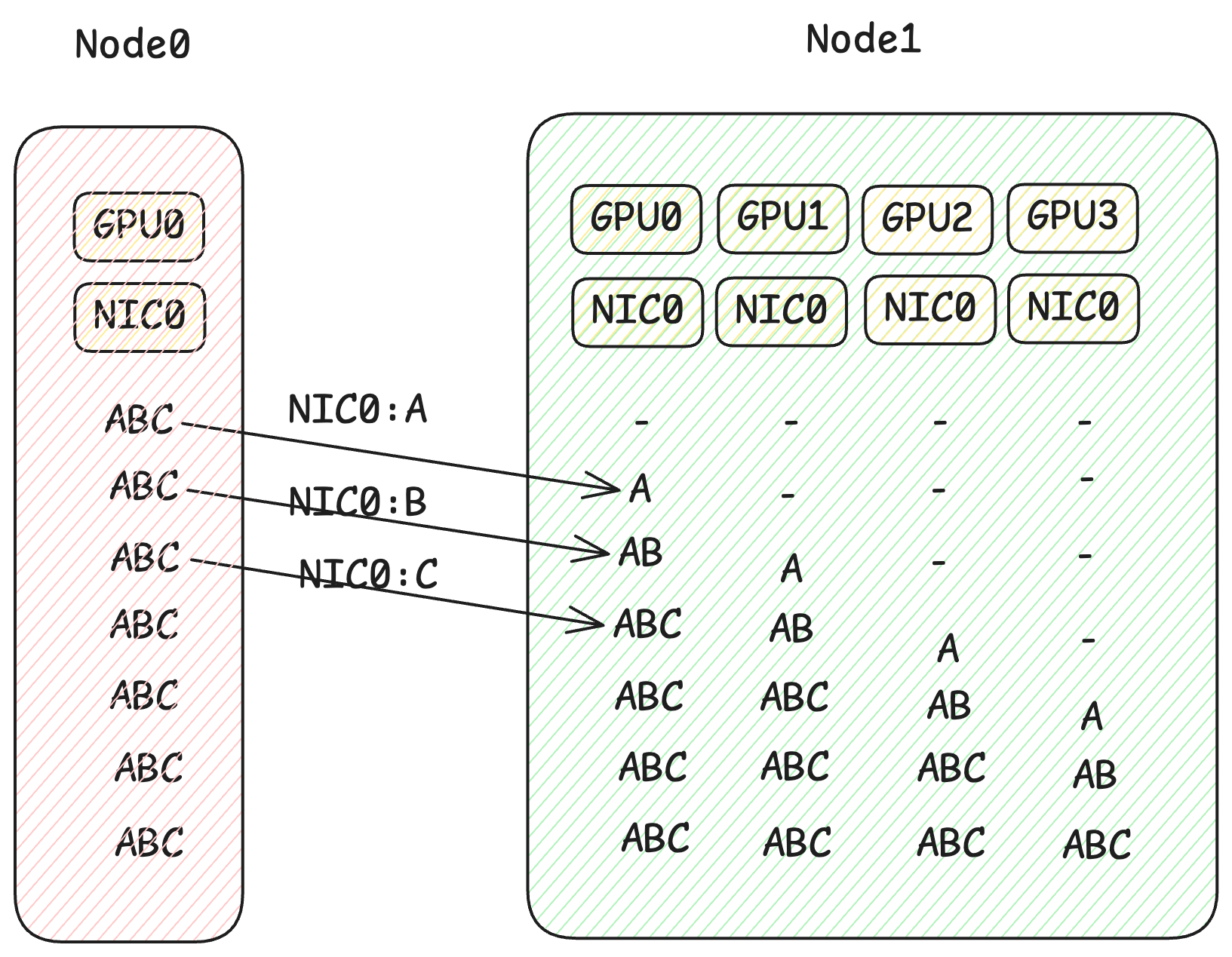
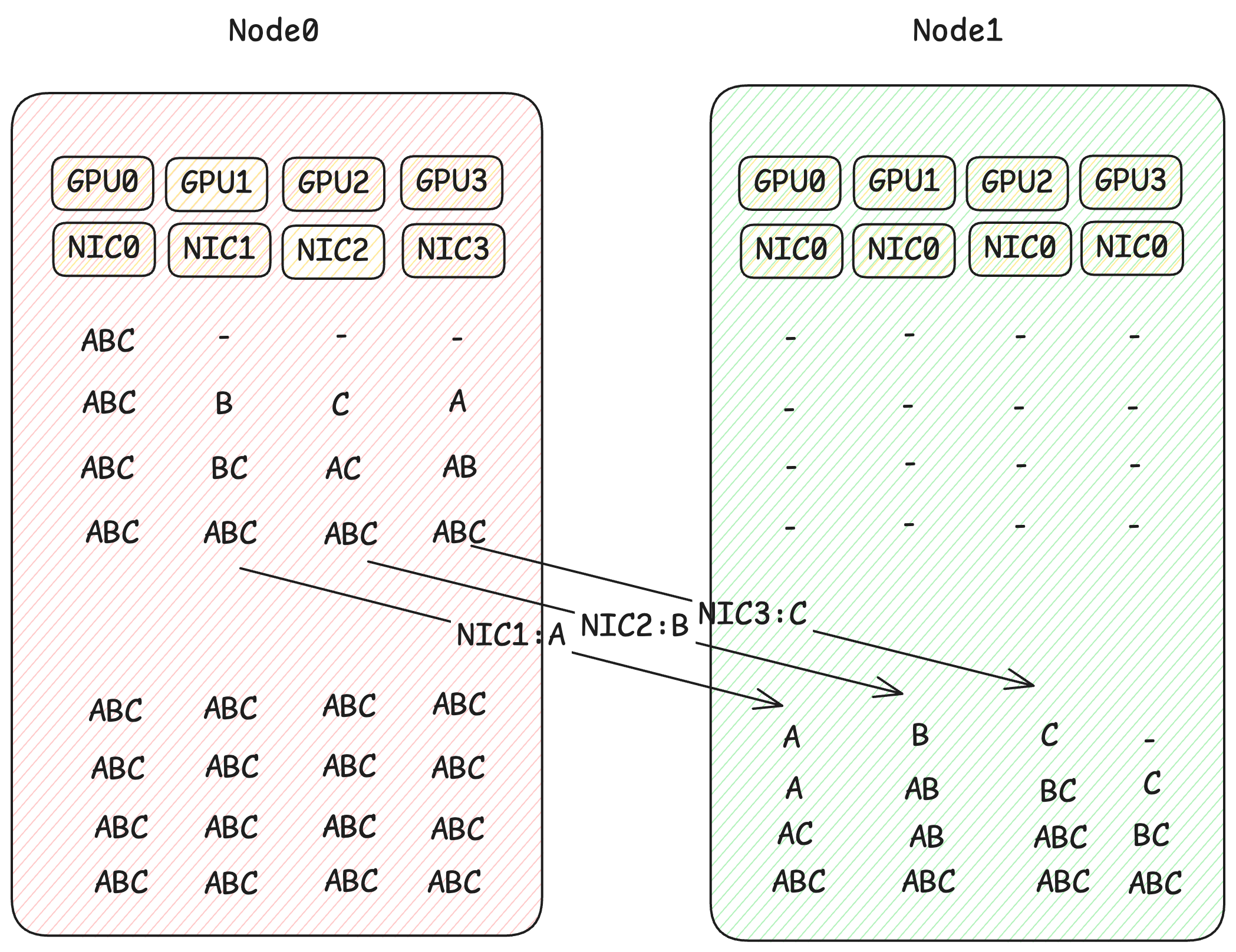
NCCL’s ring broadcast divides the buffer into chunks and pipelines them through the participating ranks. Within a node, these transfers can use fast GPU interconnects such as NVLink. Including more GPU ranks on the sender node gives NCCL additional paths through local GPUs and their nearby NICs. Our second configuration places all GPU ranks on both nodes in a single process group, as illustrated below. Whether traffic spreads across multiple NICs depends on the topology and the channel layout NCCL chooses; adding ranks alone does not guarantee it. This configuration is distinct from using multiple process groups to distribute transfers.
Experiment#
Environment#
Hardware: two Cambrian nodes, each with 8 × NVIDIA H100 80GB GPUs.
Software: PyTorch 2.11.0+cu130, CUDA 13.0, NCCL 2.28.9, NVIDIA driver 570.172.08.
Benchmark: 1 GiB BF16 broadcast, 300 seconds per configuration.
NCCL: default settings, with
NCCL_DEBUG=INFO.
Single-sender baseline#
Run these commands from the repository root on each node. They launch one
sender process on node 0 and eight receiver processes on node 1. Set
MASTER_ADDR to the sender node’s address on both nodes, then run the
corresponding command on each node. Each command uses --seconds 300 to set
the experiment duration.
# First node (node rank 0)
export OMP_NUM_THREADS=1
torchrun --standalone \
  --nproc-per-node=1 src/nccl/broadcast.py \
  --node-rank 0 \
  --sender-ranks 1 \
  --master-addr ${MASTER_ADDR} \
  --seconds 300

# Second node (node rank 1)
export OMP_NUM_THREADS=1
torchrun --standalone --nproc-per-node=8 \
  src/nccl/broadcast.py \
  --node-rank 1 \
  --sender-ranks 1 \
  --master-addr ${MASTER_ADDR} \
  --seconds 300
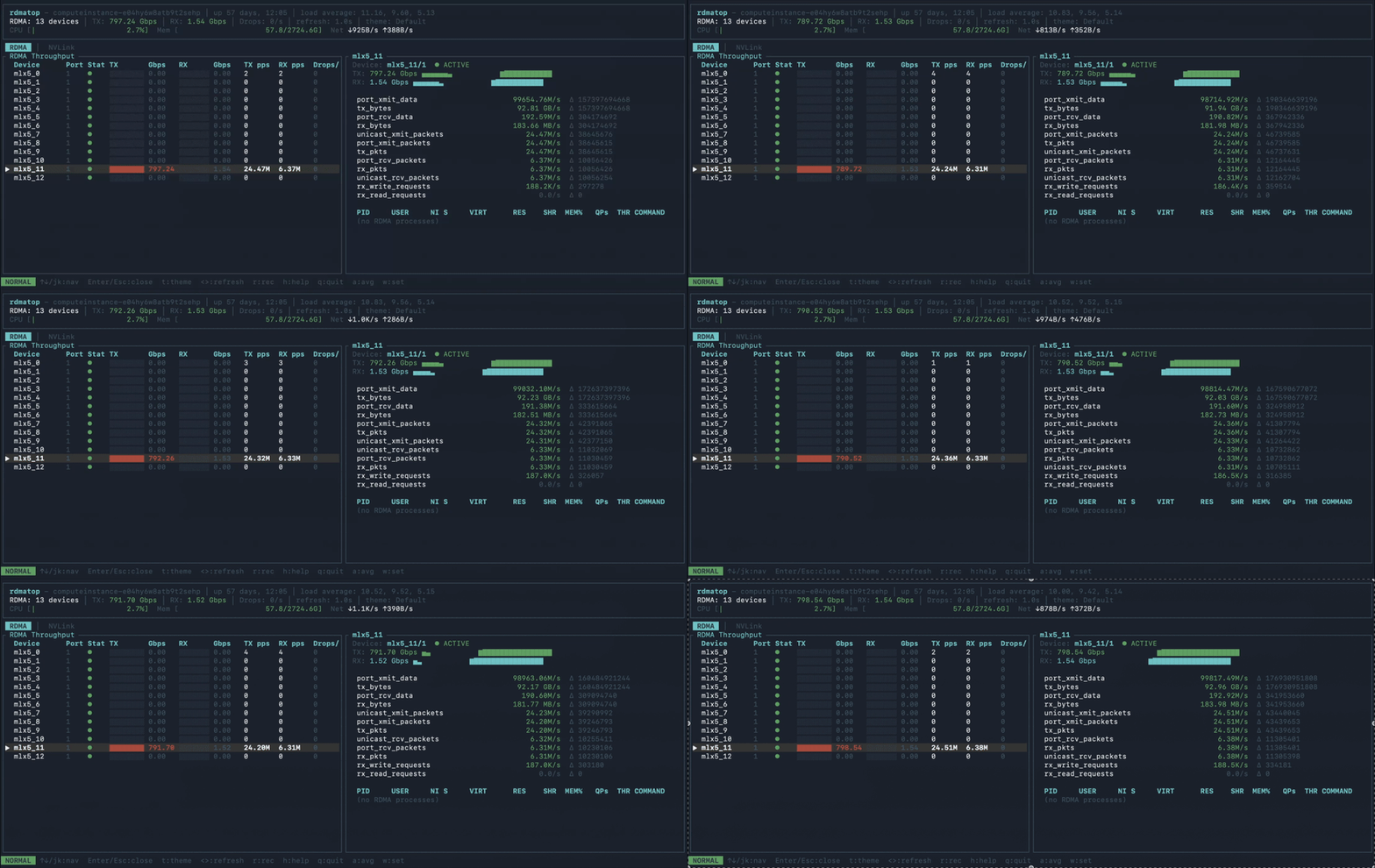
The baseline achieves a median of 47.86 GB/s, close to the 50 GB/s raw line rate of a 400 Gb/s port pair. All ranks pass the payload check.
The figure below is an earlier rdmatop capture illustrating traffic
concentrated near the source GPU. For the Cambrian run reported here, NCCL’s
logs identify the source’s virtual device as mlx5_11. RDMA counters
show bulk traffic split across those two 200 Gb/s ports while the remaining
source-node ports are effectively idle.
Eight ranks on the source node#
For the second configuration, launch eight processes on both nodes and set
--sender-ranks 8 on both commands. The payload size, measurement duration,
and broadcast source remain the same.
# First node (node rank 0)
export OMP_NUM_THREADS=1
torchrun --standalone --nproc-per-node=8 \
  src/nccl/broadcast.py \
  --node-rank 0 \
  --sender-ranks 8 \
  --master-addr ${MASTER_ADDR} \
  --seconds 300

# Second node (node rank 1)
export OMP_NUM_THREADS=1
torchrun --standalone --nproc-per-node=8 \
  src/nccl/broadcast.py \
  --node-rank 1 \
  --sender-ranks 8 \
  --master-addr ${MASTER_ADDR} \
  --seconds 300
Results#
Both experiments use one NCCL process group:
1 → 8: one group containing 9 GPU ranks.
8 → 8: one group containing 16 GPU ranks.
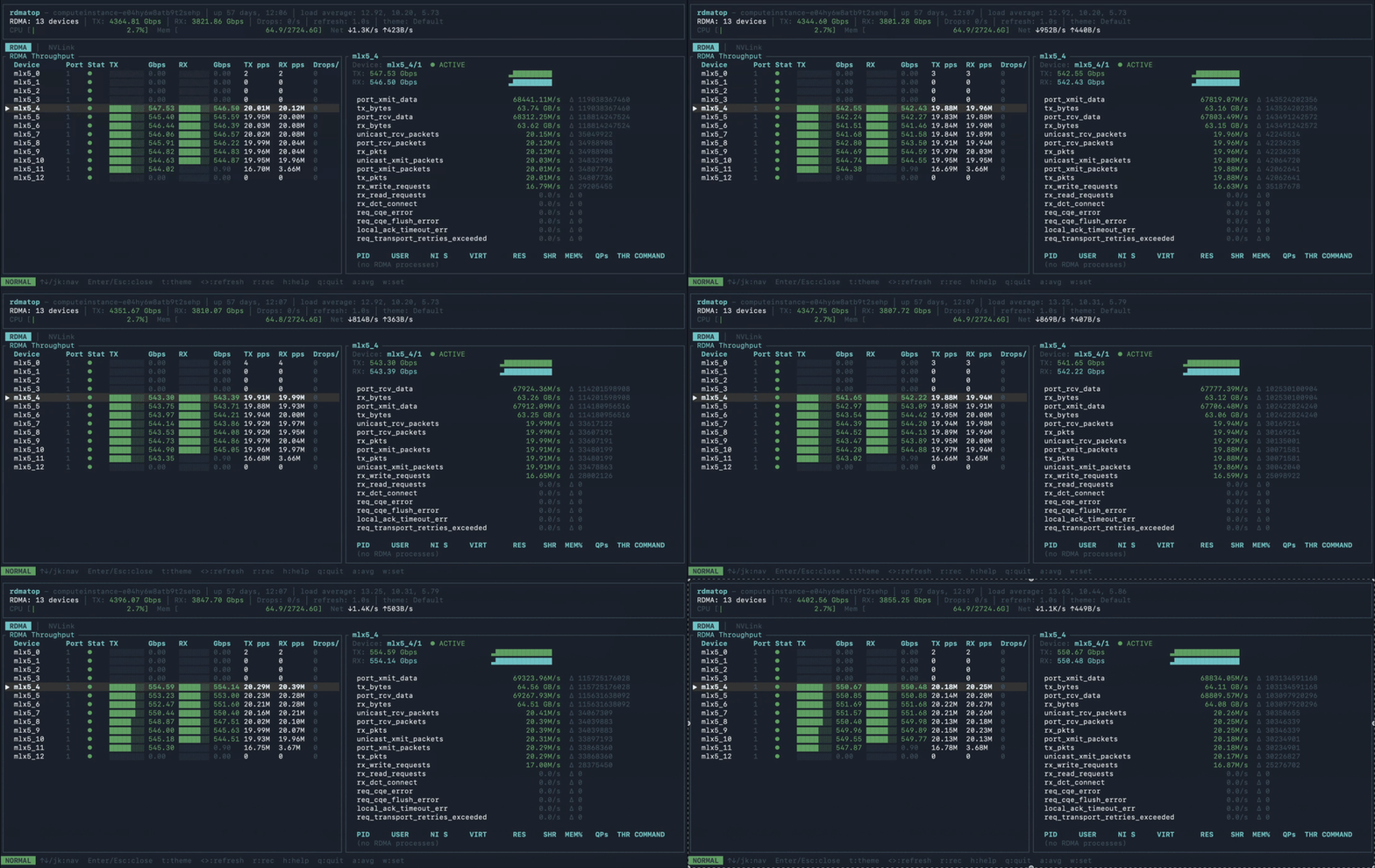
Adding source-node ranks increases median broadcast throughput from 47.86 GB/s to 290.17 GB/s, a 6.06x speedup. This may seem counterintuitive: passing data through more processes introduces additional transfers. In this setup, however, distributing data across local GPUs over NVLink allows NCCL to use more NICs in parallel. The gain in aggregate network bandwidth outweighs the cost of those transfers.
Source-node ranks |
Receiver ranks |
Median (GB/s) |
Range (GB/s) |
Speedup |
|---|---|---|---|---|
1 |
8 |
47.86 |
47.86–47.87 |
1.00x |
8 |
8 |
290.17 |
282.12–290.39 |
6.06x |
Conclusion#
In our experiments, including more source-node GPUs in one process group allows NCCL to use more NICs in parallel. For large payloads, the additional network bandwidth outweighs the overhead of local GPU transfers. This makes the approach useful for bulk transfers such as synchronizing model weights between training workers and rollout engines during GRPO.